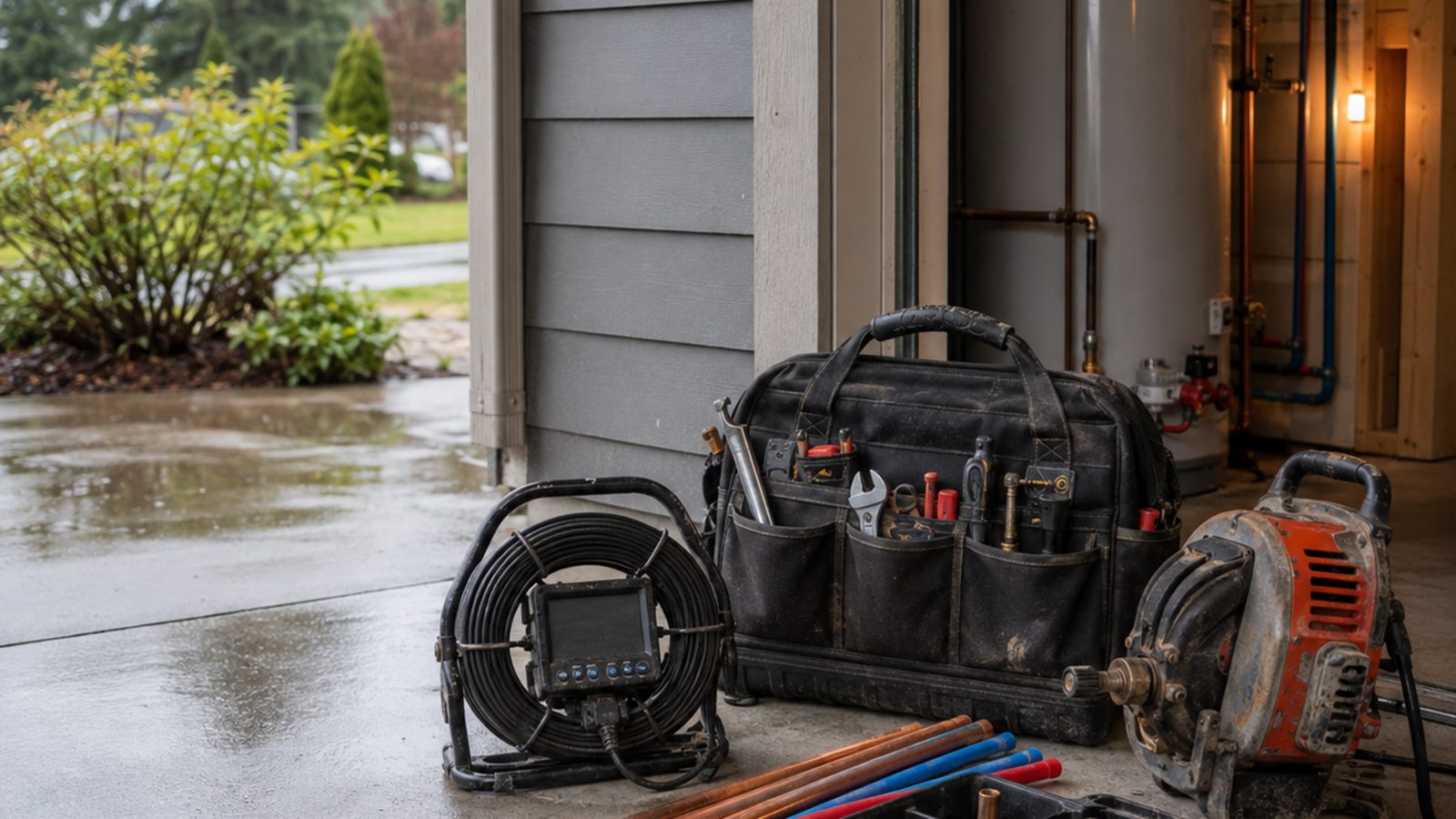
Residential and light commercial plumbing for Roseburg and communities throughout Douglas County. From drain and sewer problems, leaks, water heaters and repiping to remodels, excavation, emergency work and specialized systems — free estimates, and completed work backed by a one-year parts-and-labor warranty.
Hydro jetting, snaking, and camera inspection so you see what's actually in the line.
Repair and replacement, tank or tankless, sized to the house instead of to the invoice.

Slab leaks and pinholes located and repaired with the least demolition we can manage.
Repipes and main water line replacement for older homes still on failing galvanized or poly.
Toilets, faucets, sinks, tubs, disposals, and the rough-in behind a remodel.


We run our own excavation, so sewer and water lines that have to come up out of the ground don't need a second contractor scheduled behind us.

Range, dryer, water heater and outdoor lines run and pressure tested.
The work most repair shops send somewhere else.
Radiant loops laid and pressure tested over foam board before the pour, manifolds set and documented so the finished slab isn't a mystery later.

Whole-house filtration and conditioning, plumbed in at rough-in rather than bolted on afterward — which matters on the well systems all through the county.

Solar hot water tied into conventional tanks with the pumps, expansion and controls to actually run it.

Contractors and builders: underground rough-in, top-out, finish and excavation on new construction and commercial jobs.
New construction & commercial →Straight answers to the things people notice before they call. Some of these you can check yourself in two minutes.
If it clears after running for a minute, that's usually corrosion inside older supply lines — common in homes still on galvanized pipe. If it only shows up on the hot side, the water heater is the more likely source. Discoloration that never clears is worth having looked at, because several different conditions produce the same symptom.
Three usual causes: a failed lower heating element on an electric tank, a dip tube that has broken down and is letting cold water mix straight into the outlet, or sediment taking up the volume the tank is supposed to hold. All three are diagnosable in one visit, and only one of them means you need a new heater.
Sudden loss across the whole house usually points to a failed pressure regulator or a break somewhere on the supply side. Gradual loss over months is more often corroded supply lines narrowing from the inside. One fixture alone is almost always a clogged aerator or cartridge — that one you can often fix yourself.
Most often a dry P-trap in a fixture nobody uses, which lets sewer gas come back up through the drain. Run water in it for thirty seconds and see if the smell clears. If it doesn't, or if the smell is in several drains at once, you're looking at a venting problem or a partial blockage holding waste in the line.
Gurgling is air getting pulled through the water in a trap because it can't get in through the vent. That means either a blocked vent stack or a partial blockage further down the drain line. It's an early warning — gurgling usually shows up weeks before a real backup.
Water trapped under a layer of mineral sediment at the bottom of the tank, boiling and forcing its way out. It means the burner is working through an insulating layer to heat your water, so you're paying more for less. On an older tank it's also a reasonable sign the end is closer than the beginning.
The classic signs are a warm spot on the floor, the sound of running water with everything off, an unexplained jump in the water bill, and cracking or dampness at the base of a wall. The fastest check you can do yourself: shut every fixture off and watch the water meter. If it's still moving, water is going somewhere.
The lateral running from your house out to the main is generally yours. The main under the street is generally the city's. A camera in the line tells us which side of that boundary the problem sits on before anyone starts digging or making phone calls.
Usually where the supply line enters the house — a crawlspace, a garage wall, or a basement — plus a second one at the meter near the street. Find both today, while it's dry and light out. The difference between a burst line that costs a repair and one that costs a remodel is how many minutes pass before somebody turns the water off.
Almost always the water heater or the lines immediately downstream of it, not the house supply. Sediment in the tank, a partially closed shutoff valve on the heater, or scale in the hot lines of an older home. Cold pressure being normal actually narrows it down nicely.
Roseburg, Sutherlin, Winston, Glide and Myrtle Creek. If you're somewhere else in Douglas County, call and ask — we'll tell you straight whether we can get to you.
No. Estimates are free.
Yes. Emergency hours are 5pm to 6am.
Yes, on most repair calls.
Yes to all three, in Oregon under CCB #258626. You can look that number up on the Oregon Construction Contractors Board site, and you should, for any contractor you hire.
One year on parts and labor.
Three generations. The plumber who runs the shop has 30 years in the trade and his son works alongside him as a plumber as well. Plummer's Plumbing LLC has been operating under its own name since 2004.
Yes. Sewer and water line replacement, trenching and underground repairs are handled in house rather than subbed out, which usually means one schedule instead of two.
We handle residential and light commercial plumbing. Larger commercial jobs, call and we'll tell you honestly whether we're the right shop for it.
Most homes have a shutoff where the main line enters the house, and a meter shutoff at the street. Find both now, before you need them — it's the single best thing a homeowner can do to limit water damage.
Tell us what's happening and get a straight answer on what it takes — and what it costs. Estimates are free.
(541) 679-1722